
Tag - 2025

Year

smiling person in front of a food truck

FEED Initiative: Empowering Food Entrepreneurs in Wisconsin

Food entrepreneurship is a powerful tool for economic growth, but success requires navigating business planning, licensing and financial regulations. The Food Entrepreneurship Ecosystem Development (FEED) Initiative, led by the University of Wisconsin Extension, provides hands-on support to early-stage food businesses.  In 2024, FEED connected with over 400 participants through a webinar series, an in-person summit and specialized workshops. The annual [...]

Read more...
a group of seniors playing a game together in the park

Engaged Neighbors Programs reduce social neighborhood isolation in Missouri 

With increasing social isolation impacting American life, the University of Missouri Extension launched the Engaged Neighbor Programs in 2019, recognizing neighborhoods as key to rebuilding social connections. This effort led to the establishment of Missouri Good Neighbor Week in 2022, a statewide initiative promoting civic engagement and stronger communities.  In 2024, the weeklong celebration inspired over 31,000 acts of neighboring, [...]

Read more...
a hand touches a growing plant

Extension, Food Bank partner to satisfy food demand, while opening economic opportunities to local farmers

A Maryland Food Bank needs assessment showed a growing desire for more non-native vegetables. An alternative crop specialist with the University of Maryland Eastern Shore Extension noted the economic opportunity for farmers. Alternative crops are high value, creating a niche market that sets small-scale farmers apart from commercial growers and increases their income potential. In 2023, the alternative crop specialist [...]

Read more...
dry, cracked soil

Helping farmers affected by natural disasters with their mental health resiliency and safety

Drought, flooding and fire risk increasingly impact the mental health and safety of farmers, who are already less likely to seek mental health support. Ensuring the well-being of food producers ensures sustainability and resilience of our agricultural sector. To address issues of drought and water scarcity affecting farmers’ mental health, Oregon State University Extension and community programs in southern Oregon [...]

Read more...
cup being filled with water from a sink tap

Water resiliency programs directly help individual households

Water quality is a growing concern due to pollutants in streams, ponds, wetlands and groundwater. Extension programs in Pennsylvania and New Hampshire have successfully raised awareness and promoted remediation.  The Pennsylvania State University Water Resources Extension Team created the Safe Drinking Water Clinic, reaching 4,800 people annually. These clinics help identify health and aesthetic standards violations, leading to long-term cost [...]

Read more...
two young teens running on a school track

Health without barriers: Addressing youth obesity and mental health

Youth obesity and its associated cardiometabolic health challenges remain pressing public health concerns in the United States, disproportionately affecting rural, low-income and other communities. Limited access to high-quality health programs exacerbates these disparities, particularly in La Plata County, Colorado, where Native American and Latino populations face heightened risks of obesity, depression and related health conditions.  Recognizing this urgent need, Colorado [...]

Read more...
farmer looking into the distance

Extension equips Colorado’s rural communities to address mental health challenges

Rural Colorado communities face significant mental health challenges due to isolation, limited access to services, and stigma. Cultural expectations like “Cowboy Up” worsen these barriers. Farmers and ranchers are especially vulnerable, with higher suicide rates than the national average. A 2024 report shows nearly all Colorado counties have behavioral health provider shortages, intensifying the crisis. To address this issue, Colorado [...]

Read more...
teapot and cup of green tea

Compounds in green tea have potential to benefit gut health and mitigate inflammation

Metabolic syndrome (MetS) affects over 34% of Americans and is a major risk factor for severe cardiometabolic disorders such as diabetes, obesity and high blood pressure. Researchers at the Ohio Agricultural Research and Development Center are building on previous findings by investigating the potential of green tea extract to support gut health and mitigate inflammation in individuals with metabolic [...]

Read more...
a closeup on two people holding hands

Extension helps Wisconsin residents tackle daunting task of end-of-life planning

It’s a subject no one wants to talk about: end-of-life planning. It can be a confusing and emotional topic but being proactive in making these plans can alleviate future stress and financial burden on loved ones.  Only 37% of Americans have completed Advance Care Directives. When Extension educators with the University of Wisconsin discovered a need for more educational outreach [...]

Read more...
a marshy landscape with mountains in the distance

Extension helps Nevada counties gather planning, economic data

When county governments in Nevada apply for grants, want to assess the potential impact of a new industry or respond to federal public land inquiries, they can turn to the Nevada Economic Assessment Project for in-depth, up-to-date data and analysis.  Led by Extension professionals with the University of Nevada, the project collects and maintains baseline information on general demographic, social, economic, [...]

Read more...
youth learn about financial education in a fair setting

Empowering Arkansas families to make informed financial decisions

The Financial Capability Survey revealed that nearly 20% of Arkansans report spending more than their income, and 50% do not have an emergency savings fund. Additionally, 67% could not correctly answer more than three of five questions about financial management.  Extension programs can enhance financial stability, reduce economic stress and contribute to stronger, more resilient communities. The University of Arkansas [...]

Read more...
a young child in a highchair eats a piece of broccoli

Extension educates families on the link between poor diet, dental cavities in young children

Dental decay is the most common chronic condition in children, and those from families with low-income experience poor diet quality and cavities. Families face challenges in promoting healthy diets and dental care to their children due to barriers such as lack of transportation, targeted advertising and limited access to healthy foods. The University of Connecticut Extension supports the SNAP-Ed nutrition [...]

Read more...
person hiking wearing a baby carrier

Integrating biodiversity conservation with outdoor recreational activities for public well-being

More than 6 million visitors enjoy the trails of the White Mountain National Forest in New Hampshire annually, as hiking plays a significant role in the state’s recreational tourism economy. A study supported by the New Hampshire Agricultural Experiment Station is investigating how the biological diversity of forests impacts the psychological well-being of hikers, helping understand the relationship between [...]

Read more...
aerial view of rural homes

Multistate research shows health effects from chronic stress impact rural residents more than urban

A study led by a team of Pennsylvania State University researchers has shown that living rurally is associated with more “wear and tear” on the body’s system from exposure to chronic stress than for urban residents. The findings were published in the journal “SSM–Population Health.”  Studies have long shown that rural populations in the United States have worse health outcomes than [...]

Read more...
a woman farmer checks on a cow

Program for women farmers increases well-being, safety and productivity

Nationally, women account for 36% of all U.S. agricultural producers and 41% of beginning farmers. The Northeast corridor, which extends from Maine to West Virginia, is home to many of the counties with the highest percentage of women farmers.   Yet, U.S. Department of Agriculture data consistently show that farms in which a woman is the primary operator tend to be [...]

Read more...
honey sale sign at a farmers market

Developing new farmers, new products and new markets to boost agriculture sector

Many communities across the United States are seeing a decline in the agricultural workforce as experienced farmers retire. This issue has been exacerbated by national declines in new and beginning farmers. Land-grant universities are working to recruit and train new farmers, address their challenges and find ways to help them to thrive, including new crops and new marketing opportunities. [...]

Read more...

Land-grant researchers and Extension educators protect essential pollinators

Pollinators play a critical role in the world’s ecosystems, facilitating the reproduction of flowering plants and ensuring the production of many crops. But many pollinator populations are declining or at risk due to habitat loss, pesticide use and changing environmental conditions. Researchers and Extension educators at land-grant universities across the United States are finding ways to protect pollinators. Here are [...]

Read more...

Land-grant university research helps stakeholders lower costs with renewable energy solutions

Non-renewable energy sources are limited, and growing demand exacerbates pollution and health issues. Enhancing energy efficiency and developing renewable sources are crucial to meet demand, reduce costs, create jobs and boost rural prosperity. Reducing fossil fuel reliance improves national security and public health. Researchers and educators in the Land-grant University System are finding innovative ways to improve energy efficiency [...]

Read more...
two teens wearing goggles and using tools in a workshop setting

Missouri Manufacturing Academy builds awareness of career opportunities

In Missouri, manufacturers produce everything from state-of-the-art fighter jets to the powder that is found on Frosted Flakes cereal. The manufacturing sector employs more than 300,000 people in the state with an average annual salary of more than $67,000.  Missouri manufacturing facilities, however, have reported challenges in hiring and retaining employees. To help fill this workforce gap — and educate [...]

Read more...
a group of people outdoors, smiling

Cultivating mental health resilience

The Land-grant University System is tackling mental health challenges through innovative programs. Extension professionals are uniquely positioned to educate and support urban, suburban and rural communities, offering programs that teach coping skills, recognize mental health signs, and normalize conversations about mental health. Addressing mental health is crucial because it enhances overall well-being, improves quality of life and fosters healthier, [...]

Read more...
closeup on hands planting seeds in a garden plot

California Extension partners to plant therapeutic garden for those in transitional housing

California has one of the highest populations of unhoused people in the nation, 44 out of every 10,000 people do not have stable housing. Being unhoused is strongly tied to food insecurity, including a lack of access to fresh foods, like fruits and vegetables.  When Alameda County CalFresh Healthy Living, University of California Cooperative Extension (CFHL, UCCE), decided to restart [...]

Read more...
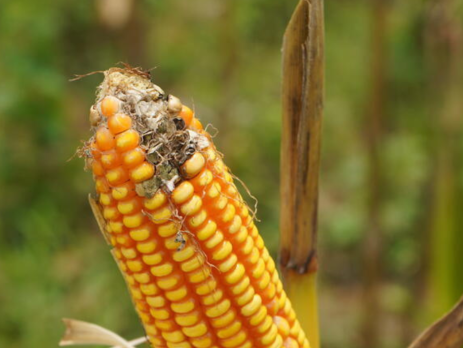
ear of corn with fungal growth

Mitigating fungal contamination of cereal grains with light

Fungal contamination threatens food security and public health and causes significant economic losses, especially in cereal crops. Aspergillus flavus and Fusarium graminearum are particularly impactful, with Fusarium alone causing over $300 million in annual U.S. losses.  Researchers at the University of Illinois Urbana-Champaign found that far-ultraviolet-C light (222-nanometer wavelength) effectively kills these fungi without harming grain quality. This treatment, safe [...]

Read more...
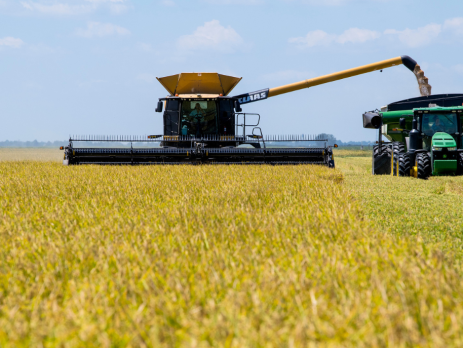
rice harvester

Developing informed guidelines for safer rice storage

Rice is a crop critical to the food security of citizens in the United States and globally, where half the world’s population relies on rice as a staple. However, an estimated 15% of rice production is lost annually due to contamination from fungi and other harmful organisms. When rice is exposed to high temperatures and humidity in storage, the [...]

Read more...
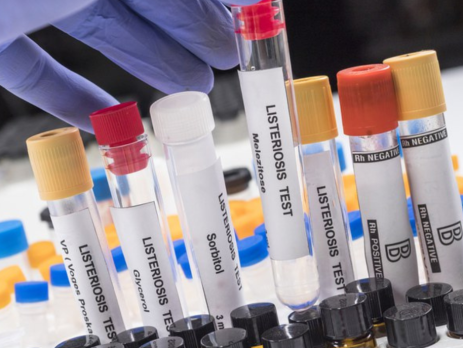
close up of experimental vials

Team finds ways to protect apples postharvest

Pennsylvania is the nation’s fourth largest producer of apples. Once these apples and other tree fruits are picked, they are sent to packing facilities where the fruit can come in contact with germs such as listeria that can survive in these cold and wet environments.  Pennsylvania State University researchers studied the seasonal changes in three different packing facilities and identified [...]

Read more...
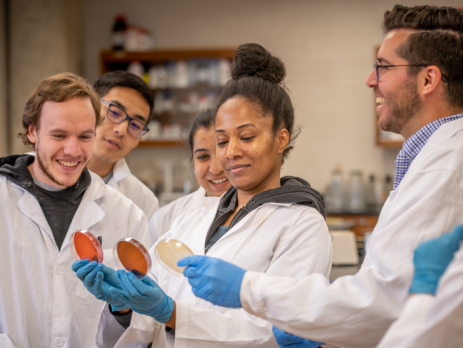
a group of scientists look at samples of petri dishes

Using genomics and machine learning to predict food-borne illness outbreaks

Each year about one in six Americans get sick from contaminated food. The germs that cause food-borne illnesses – like E. coli, salmonella and listeria – pop up throughout the food system. These outbreaks are hard to predict because scientists don’t yet know enough about how the germs survive and proliferate.  At the University of Maryland, researchers received funding from [...]

Read more...