Making aquaculture more productive, safe and economical
The seafood industry is economically vital and provides an important source of protein for the world. Challenges to aquaculture include inefficient production methods, expensive feed inputs and food safety. Land-grant efforts are protecting and promoting this booming industry.
Here are a few examples of that work:
- As feed is the most expensive cost of aquaculture, researchers in Alabama are developing feeds that reduce production costs, minimize environmental impacts and lessen the need for expensive and limited marine nutrient sources as feed ingredients for fish and shrimp.
Auburn University. Supported by Hatch capacity funds. See full statement and additional statement.
- Shrimp farming is one of the fastest-growing sectors in global aquaculture, but challenges include disease resistance, environmental adaptability and production inefficiency. Arkansas researchers are collaborating with a leading shrimp breeding company to create innovative breeding techniques, alternative feed ingredients and advanced monitoring systems to help meet the increasing global seafood demand while ensuring environmental responsibility.
University of Arkansas at Pine Bluff Agricultural Research Station. See full statement.
- Also in Arkansas, research is underway to develop a species of brine shrimp as a high-protein feed ingredient for aquaculture and poultry diets. Traditional feed sources often rely on extensive processing and storage, limiting their availability for small-scale and indoor farming operations.
University of Arkansas at Pine Bluff Agricultural Research Station. See full statement.
- A water bacteria called Shewanella can infect fish, shellfish and humans, and its stability means it can even remain alive on food processing equipment.The more destructive strains can be resistant to antibiotics, making infections difficult to treat. In Maryland research showed 16% of oysters collected from the Chesapeake Bay were resistant to one or more antibiotics.
University of Maryland Eastern Shore Agricultural Experiment Station. Supported by Evans-Allen capacity funds. See full statement.
- Georgia researchers developed an innovative process to extract, purify and commercialize high-quality collagen and gelatin powders from cannonball jellyfish. They optimized production methods, characterized product functionality and partnered with industry and startup collaborators to bring the jellyfish collagen to market.
University of Georgia Agricultural Experiment Station; University of Georgia Cooperative Extension. Supported by Hatch capacity funds. See full statement.
- Seafood is a critical economic and nutritional resource and a major export for Rhode Island. However, some fishing practices and gaps in fisheries leadership threaten local livelihoods. A team in the state addresses these challenges through safety and resiliency training for fishing, leadership workshops for international fisheries stakeholders and educational outreach for local youths.
Rhode Island Cooperative Extension. Supported by Smith-Lever (3b&c) capacity funds. See full statement.
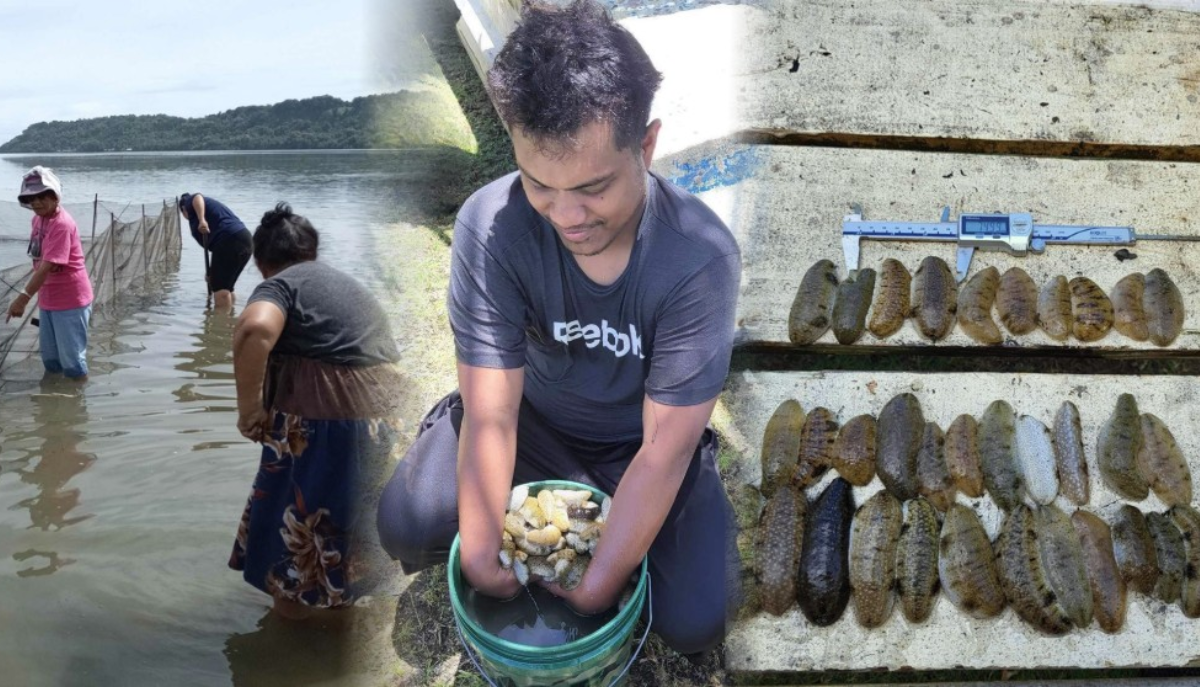
- A land-grant institution in Micronesia is researching production methods and implemented a train-the-trainer program focused on sand fish processing skills, hatchery operations and farm management. Sea cucumbers — particularly sand fish — are among the most economically valuable marine resources in the Pacific. However, over harvesting, regulatory restrictions and limited local processing capacity have constrained their potential as a sustainable livelihood option. The combined research and training is considered essential for this burgeoning aquaculture industry.
College of Micronesia Land Grant Program. Supported by Hatch capacity funds; Smith-Lever (3b&c) capacity funds. See full statement and additional statement.
Photo courtesy of College of Micronesia Land Grant Program.