
Land-grant university research and Extension drive new biofuels, bioplastics, biochar and other bio-based products, strengthening rural economies, environmental health and energy security
Here are a few examples of that work:
- Partnering with a private company, scientists in Pennsylvania roduced and tested biomaterials to replace single-use, petroleum-based plastics. New composites made from cellulose and starch have improved stability and barrier properties and have been developed into compostable food packaging and handling products; adhesives and foams for packaging, wood composites and construction materials; and improved paper and paperboard.
Pennsylvania Agricultural Experiment Station. Supported by Hatch capacity funds.
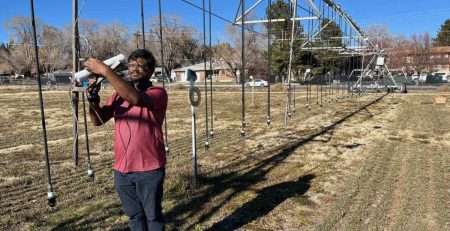
- Scientists in Illinois developed a new artificial intelligence tool that uses drone images to quickly and accurately identify subtle changes in grass flowering time across locations and species. This breakthrough could save researchers significant time and effort, making it easier to study plant traits in large field trials and speeding up development of better-adapted biofuel crop varieties that can be grown on land that is not currently profitable to farm.
Illinois Agricultural Experiment Station. Supported by non-profit grants and contracts; AFRI.
- In Washington, anaerobic digester projects have turned dairy cow manure into biogas, which can provide more than 126 million kilowatt-hours of renewable energy per year. That energy is worth approximately $2.5 million in annual value.
Washington Agricultural Experiment Station. Supported by state appropriations; Smith-Lever (3b&c) capacity funds.
- Researchers in New Hampshire piloted manure-powered heating systems that can help farmers in cold climates heat greenhouses and extend crop production. The systems offer a scalable, low-cost, renewable energy for small and mid-sized farms while also providing a waste management solution.
New Hampshire Agricultural Experiment Station. Supported by Hatch capacity funds.
- Made from crop residues and forestry waste, biochar can be added to soil to help it hold nutrients and water. Researchers in South Dakota created a new type of biochar-based fertilizer with increased holding capacity and a biodegradable coating that responds to soil conditions and controls how quickly nitrogen is released to the plants. The new biochar fertilizer increased corn yields, root growth and soil microbial health while cutting nitrogen leaching by 58%. Using this biochar, farmers improve overall profitability and protect water quality from nitrogen-induced algae blooms.
South Dakota Agricultural Experiment Station. Supported by Hatch capacity funds; Hatch Multistate capacity funds.
- Plant biochemists in Missouri and Washington charted how plant metabolism responds to genetic changes, providing fellow scientists with clues for how to tweak a plant’s oil production to create the maximum amount of biofuel.
University of Missouri Agriculture Experiment Station; Washington Agricultural Experiment Station. Supported by Hatch capacity funds.
- Scientists in Georgia developed an innovative process to extract and purify high-quality collagen and gelatin powders from cannonball jellyfish, which are harvested as bycatch and usually discarded. This work transforms an underutilized marine resource into high-value products with applications as functional food products, bioplastics and cosmetics. Local startups are commercializing products, giving coastal fishermen and seafood processors new income opportunities.
University of Georgia Agricultural Experiment Station. Supported by Hatch capacity funds.
- In West Virginia, studies showed that a coal-fired power plant byproduct can restore poor-quality soils at coal mine sites and support the growth of camelina, which can be used for biodiesel. Reusing the byproduct instead of discarding it reduces waste and disposal costs and offers a sustainable way to turn millions of acres of poor mine soil in Appalachia into productive land.
West Virginia State University Agricultural and Environmental Research Station. Supported by USDA Capacity – Research.
- In Nevada, researchers conducted the first long-term field trial of cactus pear in the U.S. Results showed the drought-tolerant plant can be grown on marginal land and produces high biomass yields for biofuel while requiring 80% less water than traditional bioenergy crops. Parts of the cactus pear can also be used as food, feed, nutraceuticals and cosmetic ingredients. Researchers gave farmers guidance on the best varieties and growing practices, reducing farmers’ labor and trial-and-error costs.
Nevada Agricultural Experiment Station. Supported by USDA Capacity – Research; Hatch capacity funds.