Emerging technology offers new tools for growers
Emerging technology is giving farmers tools to reduce the impacts of labor shortages, rising costs, changing weather patterns and regulatory demands, while improving production and profitability. These tools, using drones, robots, artificial intelligence and machine learning, offer a path to sustain productivity, worker safety and environmental performance in the agricultural economy. Projects demonstrate how these technical tools and artificial intelligence can provide practical, real-world value in agriculture while laying a foundation for additional automated technologies that improve production efficiency, sustainability and profitability.
Here are a few examples of that work:
- Researchers in Alabama are using precision agriculture to improve efficiency and profitability. Technologies such as real-time sensors on farm equipment or in the field that wirelessly transmit real-time data can accurately measure soil nutrients and moisture content. Farmers can respond to variability in soil, water, and growing conditions by providing precisely the amount of water or nutrients needed, at just the right time and in small, measured doses.
Auburn University Research. Supported by Hatch capacity funds; USDA competitive funds. See full statement.
- A pilot project is testing affordable sensors that provide real-time water and salinity data for growers in eastern North Carolina, where saltwater intrusion is an increasing problem. These tools help growers make proactive, data-driven decisions to manage flooding, salinity and saltwater intrusion, which protects crop yields, sustains farm livelihoods and strengthens the resilience of rural communities.
NC State Extension. Supported by private grants and contracts; Smith-Lever (3b&c) capacity funds. See full statement.
- Researchers at Iowa State University are leveraging artificial intelligence tools to help farmers quickly and accurately identify and manage crop pests. They have developed a web-based smartphone tool, “Pest-ID,” that enables farmers and others to upload photos of insects and weeds in the field, allowing them to identify these pests and receive research-based recommendations for their management.
Iowa Agriculture and Home Economics Experiment Station. Supported by Hatch capacity funds; USDA competitive funds. See full statement.
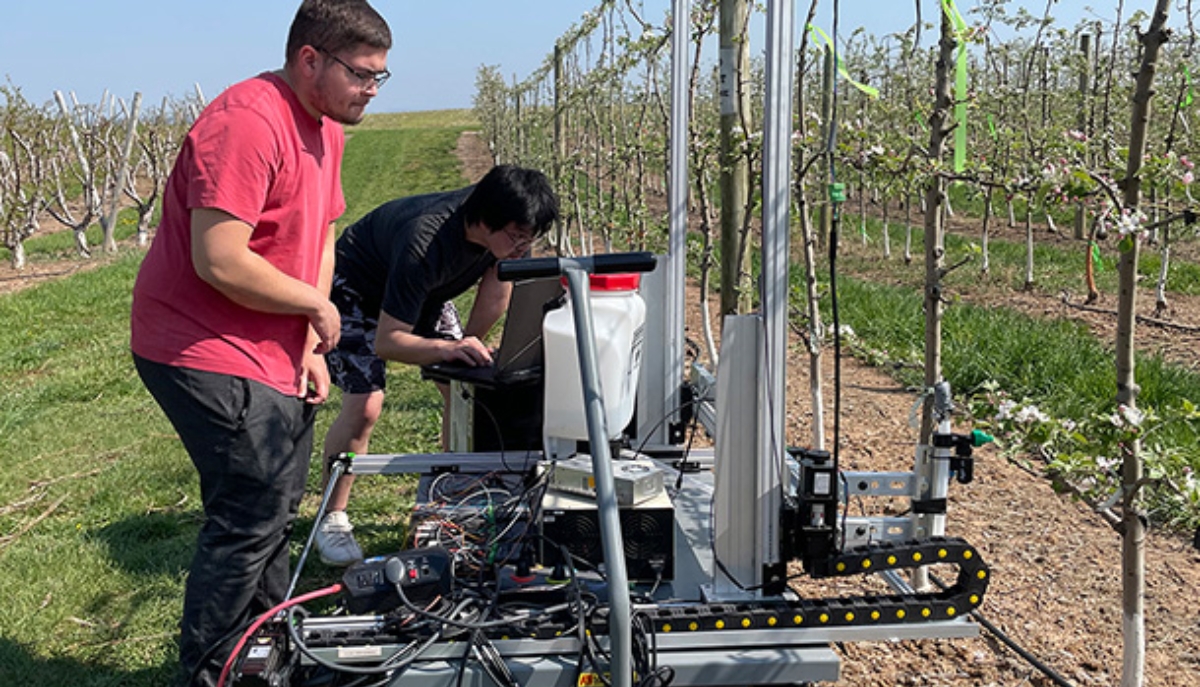
- Researchers in Pennsylvania are developing a robotic apple blossom thinning system, aiming to reduce the usage of chemical thinner while maintaining good thinning performance. In tests, flower cluster detection reached a precision of 94%. The robotic system saved 67% and 46% of chemicals compared to an air-blast sprayer and boom sprayer, respectively, while achieving a similar fruit set per cluster.
Pennsylvania Agricultural Experiment Station. Supported by Hatch capacity funds. See full statement.
- Researchers in Missouri are using drones fitted with specialized cameras over cornfields to measure chlorophyll levels, which can indicate plant health. By analyzing the images and data using artificial intelligence, it can indicate when, where and how much nitrogen should be applied. The combination of drone imagery with machine learning may also help inform farmers about the health of other crops.
University of Missouri Agricultural and Experiment Station; USDA ARS. Supported by Hatch Multistate capacity funds; AFRI. See full statement.
- Researchers in Illinois are using drones to detect the drift of a potent herbicide, Dicamba, which has been associated with human health impacts and crop damage. They have detected symptoms eight days after exposure, even at the lowest level. This advancement in remote sensing from the University of Illinois Urbana-Champaign provides a science-based tool to accurately detect and report crop damage at the field scale, reducing human error and bias, which could enable growers and policymakers to better protect sensitive plants.
Illinois Agricultural Experiment Station. See full statement.
- Mississippi scientists are developing an autonomous robotic harvesting platform designed to supplement existing mechanical methods to help producers offset rising labor costs and increase harvest efficiency. The autonomous approach has great potential to decrease reliance on manual crews, mitigate safety risks associated with hand-sorting near moving equipment, and offer more consistent productivity throughout the harvest window.
Mississippi Agricultural & Forestry Experiment Station. Supported by USDA competitive funds; state appropriations. See full statement.
- Researchers in a Mississippi lab are training intelligent cameras to identify weeds in cotton fields as part of an effort to control pesticide-resistant weeds. The cameras can quickly communicate with an on-board control system to trigger the appropriate method of control for the weed: spraying or tilling. The project harnesses artificial intelligence for real-time integrated weed management.
Mississippi Agricultural & Forestry Experiment Station. Supported by non-profit grants and contracts; state appropriations. See full statement.
- Oregon and Washington researchers are developing artificial intelligence and robotic tools for orchard management, such as measuring crop loads, disease detection and fertilizer application. They developed and field-tested a robotic fertilizer system capable of analyzing individual apple trees and applying nitrogen based on each tree’s specific health and growth needs using artificial intelligence and 3D imaging technology.
Oregon State University Extension Service; Oregon Agricultural Experiment Station; Washington State University. Supported by state appropriations; non-profit grants and contracts. See full statement.
- Illinois researchers developed autonomous robots that can navigate cornfields and quickly measure plant traits, stem width and disease resistance. Using artificial intelligence and machine learning, the robots processed the data to extract accurate phenotype information, typically a costly and time-consuming manual task. The study showed that this technology can overcome the limitations of manual data collection, enabling faster, more precise crop breeding by linking plant traits to genetics and environmental conditions.
Illinois Agricultural Experiment Station. Supported by USDA competitive funds; non-profit grants and contracts. See full statement.
Bots vs. plastic: Robots trained remove plastic contamination from cotton fields
Plastic contamination in cotton fields is a costly and persistent issue that reduces fiber quality and undermines grower profitability. Loose debris such as module wrap, grocery bags and snack wrappers results in an estimated $600–$750 million in losses across the cotton industry each year.
Mississippi scientists have developed a field-ready robotic system designed to locate and remove plastic debris before it enters the cotton harvest stream. It consists of an uncrewed aerial vehicle (UAV) to spot debris from the air. The UAV transmits the information to an uncrewed ground vehicle, which navigates crop rows to retrieve the debris. To train the detection model, researchers collected real-world plastic debris from test fields and photographed it under diverse angles and lighting conditions, building a dataset that reflects the complexity of field environments. Further developments include a robotic arm and sensors to precisely locate plastic bags and other debris.
Overall, the research establishes a viable pathway for integrating robotics and artificial intelligence into cotton production to address a long-standing quality and economic challenge.
Mississippi Agricultural and Forestry Experiment Station. Supported by USDA competitive funds; non-profit grants and contracts. See full statement.
Photo courtesy of Pennsylvania Agricultural Experiment Station.