Innovative methods for safer, healthier food production practices
Regional food production is critical to local economies and supporting American food systems. Rising reports of foodborne illnesses, increased antibiotic resistance and newer production systems like soilless agriculture necessitate a better understanding of the risks and options to improve the safety and health value of food products from produce to shellfish and tree nuts. 1890 land-grant universities are examining food safety topics from a variety of angles, finding new ways to treat harmful bacteria, studying lesser understood pathogens and reducing heavy metal contamination.
Here are a few examples of that work:
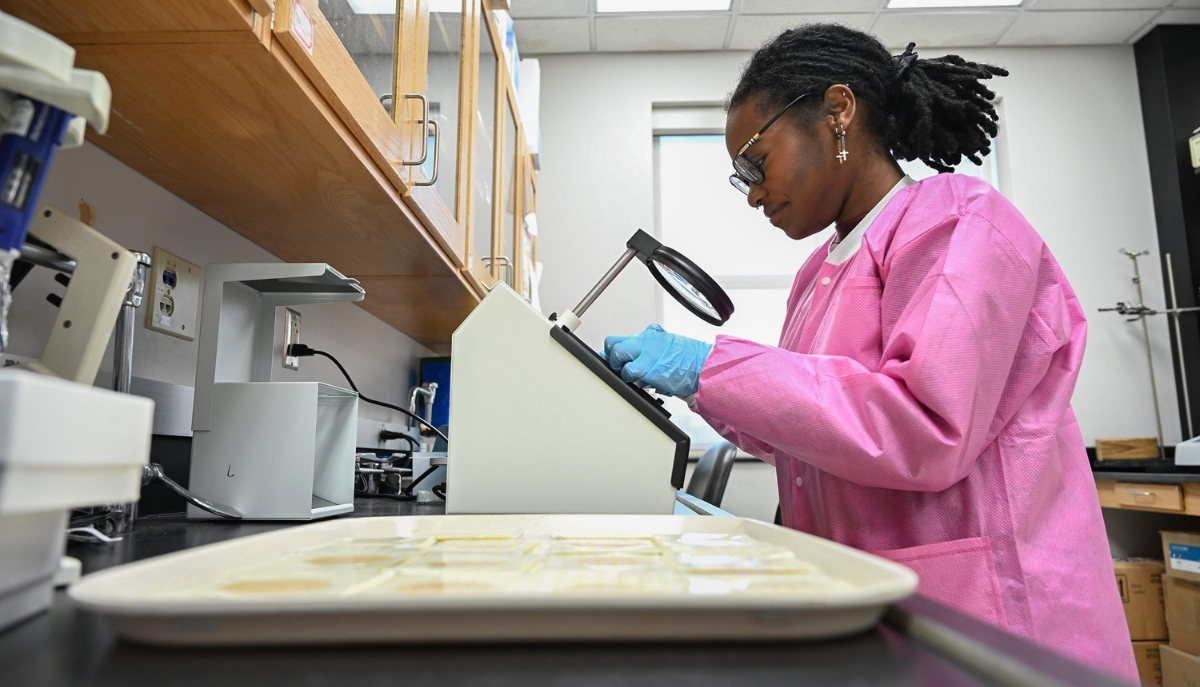
- Researchers in Maryland are studying a bacteria called Shewanella, of which many strains are resistant to antibiotics and can infect fish, shellfish and humans, causing tens of thousands of deaths across the United States and Europe every year. Research efforts focus on prevalence, antibiotic resistance, controlling spread and differentiating between potentially beneficial and harmful strains.
University of Maryland Eastern Shore Agricultural Experiment Station. Supported by Evans-Allen capacity funds. See full statement.
- A team of West Virginia researchers found that grafting tomato and watermelon plants can significantly reduce heavy metal contamination in fruits while boosting plant tolerance to metal stress in soils contaminated by mining activities. The team identified specific genes and processes that allow grafted plants to better tolerate heavy metals in soils.
West Virginia State University Agricultural and Environmental Research Station. Supported by USDA Capacity – Research. See full statement.
- Different teams of researchers in Arkansas are investigating ways to strengthen food safety from many angles, including studying innate immunity of sheep to potentially reduce antibiotic overuse, and advancing disease-resistant shrimp aquaculture with enhanced production and environmental adaptability.
University of Arkansas at Pine Bluff Agricultural Research Station. Supported by USDA Capacity – Research; Evans-Allen capacity funds. See full statement and additional statement.
- Researchers in Ohio are seeking to understand the microbial quality and potential food safety risks with specialty produce grown in aquaponics systems. The project is evaluating the focused production systems as well as produce at Ohio retail markets.
Central State University Research. Supported by Evans-Allen capacity funds. See full statement.
- In North Carolina, researchers are developing clean alternatives to chemical produce treatments like laser and ultrasound to treat harmful bacteria like E. coli on hydroponic produce.
North Carolina A&T State University Agricultural Research Station. Supported by Evans-Allen capacity funds. See full statement.
- Georgia researchers are evaluating using ultraviolet light and essential oil treatments to reduce E. coli on pecans as an alternative to thermal processing. Pulsed ultraviolet light reduced microbial contamination on pecans by 99.9% in 40 seconds, without leaving harmful residue or damaging pecan quality.
Fort Valley State University Agricultural Research Station. Supported by USDA Capacity – Research. See full statement.
Photo courtesy of Todd Dudek/UMES.