
Fine-tuning livestock production systems to overcome challenges
Livestock researchers are exploring new ways to achieve higher profitability through reproductive research, technology and traditional education outreach to help offset rising production costs.
Here are a few examples of that work:
- In Louisiana, the Geaux Beef Heifer Development Program was created to support producers with expert-guided, forage-based heifer development. The program utilized artificial insemination or natural breeding combined with expert consultation in reproduction, health, nutrition and marketing.
LSU Ag Center. Supported by Smith-Lever (3b&c) capacity funds; state appropriations. See full statement.
- Mississippi researchers evaluated breeding soundness in herd bulls. Sub-fertile bulls reduce reproductive efficiencies in cow-calf operations causing delayed conception, lighter calves and unbred, open cows. The research team evaluated the effectiveness of long-term breeding soundness examinations (BSE) to help overcome some of these challenges. The researchers found that implementing breeding soundness examinations consistently achieved higher net present value across many scenarios.
Mississippi Agricultural & Forestry Experiment Station. Supported by AFRI; state appropriations. See full statement.
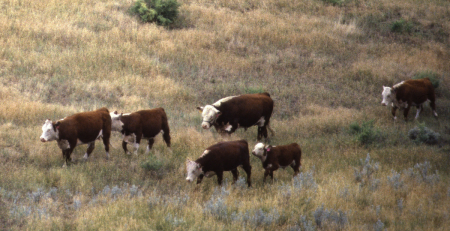
- In South Dakota, rising fencing costs, labor shortages, unpredictable forage due to weather and increased pressure to demonstrate environmental responsibility make ranching more complicated than ever. Modern precision livestock technologies, like virtual fencing, digital scales, methane sensors and behavior trackers, promise better grazing, healthier animals and more efficient use of land and labor.
South Dakota Agricultural Experiment Station. Supported by Hatch capacity funds; McIntire-Stennis capacity funds. See full statement.
Photo courtesy of David Ammon/Mississippi State University.