
Digital agriculture enhances production, monitoring capabilities
Data modeling, automated machinery and drones are just a few of the technologies that are powering improved efficiencies in livestock and crop production. Land-grant universities are at the forefront of researching and applying these technologies, paving the way for increased productivity, better disease management and optimized harvest timing.
Here are a few examples of that work:
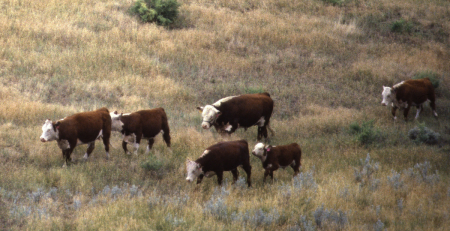
- In Idaho, many cattle producers were experiencing economic losses due to calves lost at birth. Because bull sire genetics have a significant effect on how easily a cow will calve and how well calves will perform from birth to harvest, Extension professionals in Idaho developed and shared a new genetic selection tool for identifying better bulls. Since incorporating this tool into bull grading programs, calving ease has increased dramatically and calf and cow deaths have decreased. In addition, because producers have been able to use the tool to purchase genetically superior bulls, fewer bulls are being rejected, which saves producers upwards of $4,000 per bull they do not have to replace. Improving bull selection and calving success are essential to improving the economic viability of the tribal and nontribal ranchers utilizing this range unit and to ensuring high-quality beef for consumers.
University of Idaho Extension; Smith-Lever 3D. See full statement. - Current scouting methods often detect diseases like Northern corn leaf blight too late for treatment. Researchers in New Hampshire are using drones for early disease detection in corn fields. Through the use of drone-based multispectral imaging, researchers can quickly identify disease pressure.
New Hampshire Agricultural Experiment Station; McIntire-Stennis. See full statement. - Researchers in Ohio developed robotic solutions for small-scale raspberry farms to automate labor tasks of mowing, soil moisture monitoring and irrigation. This automation saved growers on labor expenses.
Central State University; USDA Capacity. See full statement. - Researchers in Mississippi developed an advanced robotic harvesting system for blackberries. The machine vision-based system identifies ripe blackberries quickly and accurately. Using modeling systems, it can quickly identify each blackberry on a bush and its level of ripeness.
Mississippi Agricultural and Forestry Experiment Station; USDA Competitive, Hatch. See full statement.
Photo courtesy of Mississippi Agricultural & Forestry Experiment Station.