Monitoring climate change to reduce emissions and waste
Land-grant universities are working to provide critical data, tools and strategies to help predict, monitor and mitigate climate change and its impacts on communities and natural resources.
Here are a few examples of that work:
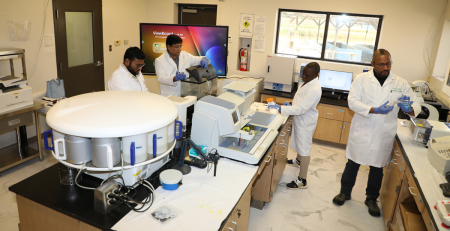
- Dairy waste is a major source of methane and nitrous oxide emissions, which contribute to global warming. Scientists in Washington showed that vermifiltration (which uses filters and worms to strip and degrade organic matter like manure) is a promising low-cost, sustainable way to convert agricultural waste into valuable byproducts. While the tested vermifiltration systems did emit some methane and nitrous oxide, the intensity was much lower than from typical manure and wastewater management used by dairies. This reduction could enable dairies to participate in carbon markets, providing an additional income stream. The team’s economic analysis will help dairy farmers make fact-based decisions about the value of implementing this kind of system.
Washington State University; project supported by state appropriations funds. See full statement. - In rural New Mexico, lack of important weather information hinders planning and response to extreme weather impacts such as droughts, flooding, heat waves, high winds and winter storms. Researchers working with the Navajo Nation have installed weather stations at Chapter Houses, government facilities, fire stations and near schools to help monitor climate and to track in areas where they have no previous data.
New Mexico State University; project supported by state appropriations funds. See full statement. - Researchers in Pennsylvania study landscape transcriptomics to determine how patterns of gene expression in living organisms relate to changes in the environment. The data open the possibility for conservationists to use new genomic tools to identify populations that are at risk and target them for habitat or other mitigation.
Pennsylvania State University; project supported by Hatch funds. See full statement. - Researchers in Tennessee are studying the effect increased soil temperatures have on microbial decomposition of organic matter and the amount of carbon dioxide that is released. In a long-term experiment, they collected data from artificially heated soils to develop simulation models of carbon dioxide release and increase the accuracy and efficiency of predictions of how the soil can retain carbon during times of climate change.
Tennessee State University. See full statement.