
Emerging technologies aid conservation and management
Climate change and biodiversity losses pose extraordinary challenges for the sustainability of natural ecosystems and the species that inhabit them. Land-grant universities are developing and applying emerging technologies that can help to more efficiently, accurately and safely monitor, measure, and precisely manage these systems with minimal environmental impact.
Here are a few examples of that work:
- In New Hampshire, researchers found that use of technologies such as camera trapping, drone surveying and integrated population models enhanced the accuracy and precision of moose population estimates, providing more comprehensive data that can inform wildlife management and conservation decisions.
University of New Hampshire; project supported by McIntire-Stennis funds. See full statement. - Arkansas Extension worked with the Arkansas Game and Fish Commission and U.S. Army Corps of Engineers to map and monitor aquatic plant growth using submersible, remote-controlled drones to verify the growth of endangered aquatic vegetation. This will guide future management decisions in restoring the ecosystem of microbes, invertebrates and vertebrates needed to sustain native populations of black basses and crappie.
University of Arkansas at Pine Bluff; project supported by 1890 Extension funds. See full statement. - Washington researchers used unpiloted aerial systems to improve detection and quantification of forest disturbance by collecting fine-scale spectral signatures of tree mortality and disease and damage by wildfire and insects. This provides critical information for forest ecosystem management.
Washington State University; project supported by McIntire-Stennis funds. See full statement. - Researchers in New Hampshire are addressing the significant environmental and public health risks of harmful algal blooms in water bodies by using a drone equipped with a multispectral sensor. Their approach, which included validating image data with targeted samples, proved over 90% effective, offering a safer, faster and more accurate method to detect and respond to emerging blooms.
University of New Hampshire; project supported by McIntire-Stennis funds. See full statement. - Researchers in Tennessee are studying the effects of increased soil temperatures on microbial decomposition of organic matter and amount of carbon dioxide released. In a long-term experiment, they collected data from artificially heated soils to develop simulation models, increasing the accuracy and efficiency of predictions of how soil can retain carbon in a changing climate.
Tennessee State University; project supported by Evans-Allen funds. See full statement. - Monitoring streamflow under extreme conditions is essential for understanding how environmental stresses affect freshwater ecosystems, but equipment to collect data can be expensive to install and maintain. Arkansas researchers adapted a low-cost system typically used to measure streamflow in human-made waterways to monitor natural channels of smaller watersheds and collect essential data to understand changes in hydrology in natural disturbances like floods and drought.
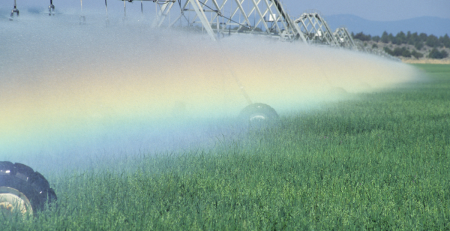
University of Arkansas; project supported by Hatch funds and state appropriations. See full statement. - Inefficient water usage, including both over- and under-irrigation, can affect production costs and environmental quality as well as crop yield and quality. Researchers in Pennsylvania developed a low-cost, easily implemented, internet-connected automatic irrigation-scheduling system that conserves water while increasing crop production.
Pennsylvania State University; project supported by Hatch and other USDA competitive funds. See full statement. - Vermifiltration systems are emerging as low-cost and sustainable wastewater treatment technologies that convert agricultural water into valuable byproducts and are of great interest to diverse agricultural industries including dairies. Scientists in Washington conducted a multidisciplinary analysis of the nutrient concentration, gas fluxes and an economic analysis to aid producers in making fact-based decisions for implementation of vermilfiltration systems.
Washington State University; project supported by state appropriations. See full statement. - Florida Extension and Master Gardener volunteers augmented physical demonstration gardens by launching a website to share information on the plants that cannot be included on traditional signage. These virtual demonstration gardens give visitors more detailed information about plants and can help gardeners make sustainable decisions about plant selection, establishment, and care. They also improve the experience of visitors by being ADA compliant and accessible online.
University of Florida; project supported by Smith-Lever (3b&c) and county funds. See full statement. - Connecticut scientists created a public-facing water quality mapping tool for the Long Island Sound watershed by compiling publicly available water quality data for streams, rivers, and groundwater. This interactive map will help multiple audiences understand water quality and make improvements.
University of Connecticut; project supported by Hatch funds. See full statement. - Using cutting-edge genomic and genetic tools, researchers in Washington examined potential predators and pathogens to the endangered northern leopard frog. Their research will guide wildlife managers on release strategies that will better protect this endangered native species and help it to repopulate.
University of Washington. See full statement. - Pennsylvania scientists used CRISPR/Cas9, a technique for editing genomes, to study the function of an insect salivary enzyme and determine a role in plant defense. Their discovery that a caterpillar can silence its food plants’ chemical defense mechanisms may yield insights into the abilities of crop plants such as tomato and soybean to withstand additional stressors, like climate change.
Pennsylvania State University; project supported by Hatch funds. See full statement. - Through a statewide effort to expand the existing weather station network, researchers in New Mexico are able to reach community members and government agencies across the Navajo Nation in the state, providing critical weather data. These data will improve weather forecasts in this area as well as provide data for planning for future drought and a changing climate.
New Mexico State University; project supported by state appropriations. See full statement.
Photo courtesy LSU AgCenter.