
Pollinators support agriculture profitability
Bees, flies, moths and other pollinators are essential to the environment. Pollinators improve the quality and quantity of farmers’ crop yields, which adds an estimated $18 billion in crop production revenue annually. Pollinators also support healthy ecosystems needed for clean air, stable soils and diverse wildlife. However, both wild and domesticated pollinators are at risk, most notably many wild bees like bumble bees, which are in serious decline due to climate change, pesticides, pathogens and land use change. Land-grant universities across the nation are working together to improve habitats and protect pollinators.
Here are a few examples of that work:
- New research from Pennsylvania is the first to demonstrate the role of agriculture as an evolutionary force acting on a wild insect pollinator and may have implications for food security.
Pennsylvania State University; project supported by Hatch funds. See full statement. - Trapping wild bees is essential to studying them. Arkansas researchers tested which colors — yellow, red or blue — worked best to attract bees to vane traps. Different light wavelengths and reflectivity influenced bee species capture rates, and blue vane traps captured the greatest diversity of species. These results can help optimize wild bee sampling methods and ultimately aid in conservation and management practices.
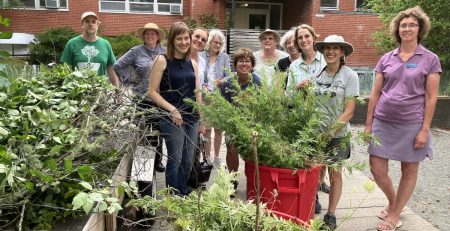
University of Arkansas; project supported by state appropriations and Hatch funds. See full statement. - A project in New York helped educate communities about beneficial insects, especially ladybugs. The project included ladybug releases, with over 1,000 ladybugs shipped to over 20 collaborators in 10 counties. The project had economic, environmental and social/psychological benefits by reducing losses from insect pests, reducing the use of pesticides and providing an opportunity to have a positive interaction with beneficial insects. By engaging with diverse audiences and providing resources and tools for successful ladybug management, the project helped promote the conservation and preservation of this important insect species.
Cornell University; project supported by Smith-Lever (3b&c) funds. See full statement. - Since 2022, an Extension pollinator program in Vermont has worked with farmers to enhance understanding of pollinator habits and help implement practices that support pollinator health and habitat. With on-farm trials, they have identified cover crop varieties that support soil health while providing needed flowers and nectar for pollinators.
University of Vermont; project supported by Smith-Lever (3b&c) funds. See full statement. - Colorado Extension offered the Native Bee Watch, a community science program that trains and supports volunteers to identify and monitor bees, generating valuable ecological data. Volunteers contributed over 4,000 plant/bee observations throughout the state, helping to increase public awareness and generate engagement to mitigate bee populations’ decline.
Colorado State University; project supported by Smith-Lever (3b&c) funds. See full statement.
Improving pollinator habitats to rebuild valuable hardwoods
Black cherry historically has been one of the premier commercial hardwoods. It’s used to make high-quality furniture, cabinets, paneling, flooring, musical instruments and more. Nearly 30% of the nation’s black cherry volume is in Pennsylvania. Yet fewer seedlings and saplings have been reported growing in the last 20 years. Data from the U.S. Forest Service show a 60% decline in established black cherry seedling densities across the entire Allegheny Plateau. Changing weather, soilborne pathogens and insect pests likely contribute to the decline. Given that black cherry is insect-pollinated and unable to produce viable seed from self-pollination, a reduction in seed crops could be due to a pollination deficit.
Identifying the pollinators and factors that influence pollinator abundance and specialization is critical for supporting and enhancing seed production. The andrenid, or miner, bee was identified as the main pollinator of black cherry trees, a valuable and declining timber species in Pennsylvania. This knowledge may lead to other research determining how to support this bee species for the benefit of black cherries.
Pennsylvania State University; project supported by McIntire-Stennis funds and state appropriations. See full statement.
Photo courtesy Carl Dennis, Auburn University.