
Indiana farmers improve technical knowledge through revived Purdue on-farm visit program
After two years of COVID-19 procedures and protocol, Purdue Extension’s connections with Indiana farmers were limited as virtual experiences replaced in-person activities.
In response, Purdue Extension developed “Purdue On The Farm” to re-connect and increase direct contact between Purdue Extension educators and Indiana farmers to build and enhance relationships, understand perception and practices and generate data to underpin recommendations.
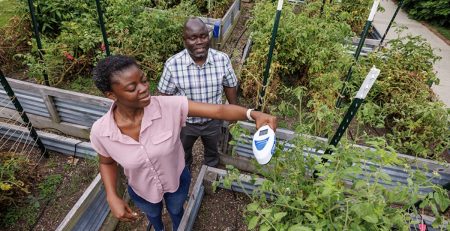
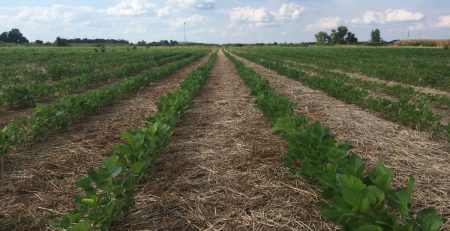
Purdue on the Farm is a corn and soybean growing-season program based on four tiers: data collection questionnaires, crop scouting for diseases and pests, demonstrations and on-farm research. Educators visited corn and soybean farms, met with farmers and completed data-collection questionnaires for fields in the spring and again at the early, middle and late points of the growing season. Fourteen educators scouted over 2,200 acres of corn and soybean in 19 Indiana counties. Ten educators scouted 21 soybean fields in collaboration with 17 farmers. Fourteen educators scouted 27 corn fields in collaboration with 21 farmers.
Key results in the scouted soybeans showed early season seedling death (9%), low soil pH and potassium in 33% of the fields and 80% of the fields with dry conditions. Key results in the scouted corn fields showed most prevalent nutrient deficiencies were sulfur and nitrogen for early and mid-season. Soil test results showed that scouted fields were below critical in phosphorus and potassium. Educators reported the greatest benefit of crop scouting was improving their technical knowledge (90%) and specifically in agronomic (45%), plant disease identification (33%) and weed identification (22%).
Project supported by Smith-Lever (3b&c) funds.