Research, education and Extension work at land-grant universities is publicly supported. We have an obligation to report a measurable difference each program makes or can potentially make. A well-written impact statement shows public accountability, your response to an issue and collaboration. It can be a tracking system for your project, offer a brief update, show return on investment and support future funding requests. Impact statements fulfill state and federal reporting needs.
2025 Call for Submissions
In early 2026, a group of land-grant university communicators will review all submitted 2025 statements and create educational materials highlighting exemplary impact statements. APLU, USDA NIFA, and others use these materials throughout the year to promote the work of land-grant universities. The team will produce multiple summaries for each emphasis area (agricultural systems; environmental stewardship; energy and bioproducts; food security; nutrition and health; youth, family, and communities). The NIDB team has identified high-priority subtopics that will be highlighted.
To be included for consideration in these efforts, please submit your statements by:
- Soft deadline: Wednesday, December 31, 2025
- The NIDB team will review statements received by this date to identify overarching themes and plan out team assignments.
- Firm deadline: Thursday, January 15, 2026
- Any statements received after this date will be considered for the 2027 materials.
Inputter Guides
The 2025 National Inputter Training took place on October 15, 2025. Download the slideshow.

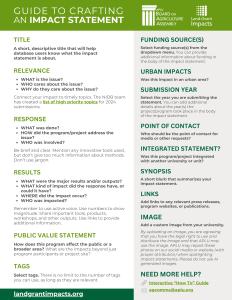
How to Craft an Impact Statement
How To:
- Log in to the NIDB
- Submit an Impact Statement
- Share Your Impact Statement
- Edit an Impact Statement
- Archive or Delete an Impact Statement
- Reset Your Password
- Tag Your Impact Statement: 2025 NIDB Tag List
Database Access
Need to add or edit inputters for your institution? Email Kim Scotto at agcomms@aplu.org.
Frequently Asked Questions
A good impact statement:
- Is short, clear, and doesn’t use jargon
- Uses third-person, active voice
- Connects the dots: what, where, when, who, how, and why
- Focuses on impact, not just program descriptions or research findings
The NIDB considers impact to be a change in knowledge/awareness, behavior, or environmental, economic, or social conditions. These changes can occur at the level of the individual, family, community, state, region, nation—or any level in between or beyond—if you’re describing a change or a difference made, it counts as impact.
Impact can be shared as quantitative or qualitative data. The NIDB welcomes anecdotes and success stories. As a best practice, we recommend including some quantitative data to help show the scope and scale of the impact. For example, you might share the percent by which yields increased, how many gallons of water communities saved, how many farmers adopted a new tool and how many acres they farm, how many dollars farmers saved, or how many older adults received fresh produce from a meal delivery program.
For some projects/programs it is difficult to measure direct impacts. In these cases, it is appropriate to submit impact statements that share “potential” impact. Your statements can explain anticipated or estimated impacts—describe how the research or program could make a difference in the future.
Submit a new one.
Impact statements in the NIDB are now in chronological order by original publication date, so submitting a new statement ensures that it’s seen earlier in search results.
The “Submission Year” will no longer automatically update to the current year when you edit a published statement. This will allow you to use the edit function to correct typos, errors, and dead links.
You may also edit a previously submitted impact statement to include text and a link to the most recent impact statement for that project. For example, if you submitted an impact statement for your institution’s blueberry breeding program in 2024, and want to submit a new impact statement showcasing that program’s impacts in 2025, you might add a line at the top of the 2024 impact statement that says: “See 2025 statement for latest program impacts.” This is not required, but we recommend it as a best practice.
If you are unsure of the funding source for a project, please contact the PI for more information. Please note that you can include two funding sources – for many projects, capacity funds may also play a supporting role in addition to the main grant/award.
Uploading a photo with your impact statement is optional. If you do upload an image, please select a photograph or simple diagram that represents the project. Horizontal photos are preferred, but not mandatory. Please do not use AI images. Please also ensure that you have the legal right to use and distribute any images uploaded.
There is no required amount of impact statements per year; most institutions submit between 5 and 15, with some sharing as many as 50. We recommend aiming for around 10 strong statements as a manageable target, to help showcase the broad range of research and programs at your institution.
The database is always open for submissions. To be included for consideration in the annual educational materials created by the NIDB Communications Team, please submit your statements by:
- Soft deadline: Wednesday, December 31, 2025
- The NIDB team will review statements received by this date to identify overarching themes and plan out team assignments.
- Firm deadline: Thursday, January 15, 2026
- Any statements received after this date will be considered for the 2027 materials.