The National Impacts Database (NIDB) is an important platform for documenting and demonstrating the collective impacts of land-grant university teaching, research, and Extension.
- 2025/2026 Deadlines
- NIDB Virtual Training: October 15, 2025
- 2025 Priority Topic Areas
- Updating Authorized Inputters
2025/2026 Deadlines
To be included for consideration in the 2026 NIDB communications teams’ efforts, please submit your statements by:
- Soft deadline: Wednesday, December 31, 2025
- The NIDB team will review statements received by this date to identify overarching themes and plan out team assignments.
- Firm deadline: Thursday, January 15, 2026
- Any statements received after this date will be considered for the 2027 materials.
2025 Inputter Training
The 2025 National Inputter Training took place on October 15, 2025. Download the slideshow.

How to Craft an Impact Statement
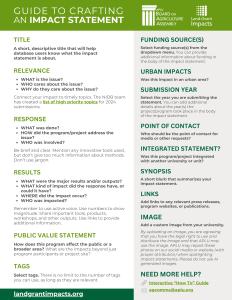
How To:
- Log in to the NIDB
- Submit an Impact Statement
- Share Your Impact Statement
- Edit an Impact Statement
- Archive or Delete an Impact Statement
- Reset Your Password
- Tag Your Impact Statement: List of Tags
2025 Priority Topic Areas
In early 2026, a group of land-grant university communicators will review all submitted 2025 statements and create educational materials highlighting exemplary impact statements. APLU, USDA NIFA, and others use these materials throughout the year to promote the work of land-grant universities. The team will produce multiple summaries for each emphasis area (agricultural systems; environmental stewardship; energy and bioproducts; food security; nutrition and health; youth, family, and communities).
The NIDB team has identified high-priority subtopics/themes that we would like to highlight.
- Increasing U.S. competitiveness and prosperity
- Improving farmers, ranchers, and forest owners’ bottom-line
- Increasing domestic food production
- Adaptive varieties of plants and animals
- Food security as national security
- Avian influenza, New World Screwworm, and other emerging pests and diseases
- Supply chain issues
- One Health
- Biosecurity/ biobased products and systems
- Rural community vitality
- Rural economic development
- Rural healthcare innovations / mobile health
- Broadband access and digital literacy
- Food deserts
- Farmer stress/mental health/safety
- Public health
- Food as medicine
- Chronic disease prevention
- Early childhood nutrition and health
- Environmental solutions
- Sustainable use of natural resources/energy conservation
- Soil health
- Regenerative ag
- Urban agriculture
- Invasive pests and diseases
- Preparation/management/recovery for extreme weather
- Artificial intelligence and other emerging technologies
- Precision farming, automation, drones, sensors, robots
- Projects that develop and/or use high tech (e.g., large-scale data)
- Projects using state-of-the-art laboratory facilities/infrastructure
- Controlled Environment Agriculture
- Workforce development/readiness
- Job creation
- Education of the future workforce
- Workforce readiness/Employability Skills
- Experiential learning
- STEM/STEAM training
- Continuing Education Certificate programs
- Support for Veterans
- AI/Digital literacy
- Positive youth development/4-H
- Civic engagement and leadership development
- College and career readiness
- Health and nutrition
- Youth mental health, opportunities for at-risk youth
- AI/Digital literacy
- Water resilience/management
- Drought, excess soil moisture, flooding, quality in an agricultural context
- Sustainable use and reuse
- Water issues focused on production and environmental sustainability
Please submit your impact statements even if they do not fall into these special priority topics. All of your impact statements are incredibly valuable and can be used in many ways.
Updating Your Authorized Inputters
Need to add or edit inputters for your institution? Email Kim Scotto at agcomms@aplu.org.