Illinois researchers use designer biochar to tackle nutrient pollution
Farmers apply fertilizer to crops to help them grow, but nitrogen and phosphorus in those fertilizers can seep from fields into adjacent waterways and degrade water quality. Once in waterways, nitrogen and phosphorus pose threats to drinking water supplies and to habitat for aquatic organisms. They can also contribute to harmful algal blooms in the Gulf of Mexico.
Researchers at the University of Illinois at Urbana-Champaign Department of Agricultural and Biological Engineering worked with the Prairie Research Institute to identify a material that removes phosphorus from drainage water and can even be reused as a slow-release fertilizer.
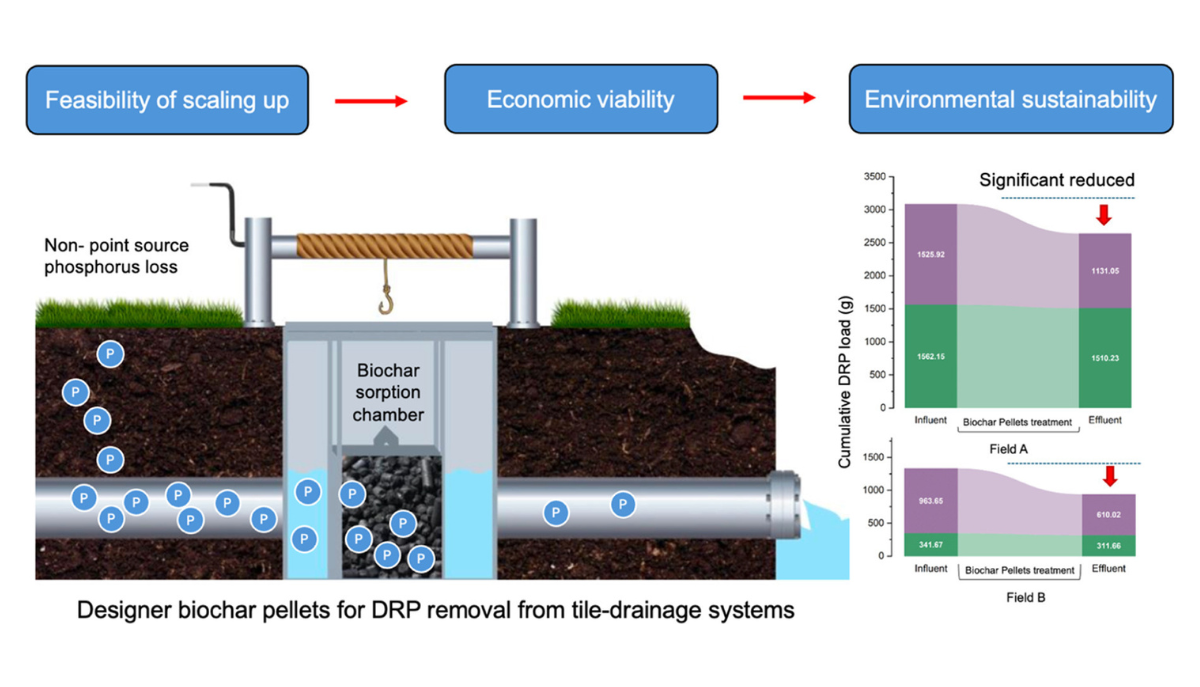
Lab studies showed designer biochar, made from sawdust treated with lime sludge from drinking water plants, are effective at removing phosphorus from water. The researchers created designer biochar pellets in different sizes and placed them in phosphorus removal structures in a Fulton County, Illinois field.
They found 1-centimeter pellets reduced 38%-41% of the phosphorus in the drainage water, removing more phosphorus than larger pellets.
The researchers evaluated the costs for farmers and the system’s overall sustainability. They estimated the cost to produce the pellets was $413 per ton, which is less than half the market cost of granular activated carbon ($800 to $2,500 per ton). Phosphorus removal costs an average $359 per kilogram removed, which varies according to inflation and how often the pellets are replaced.
An analysis showed using the designer biochar pellets could save 12 to 200 kilograms of carbon dioxide-equivalent for every kilogram of phosphorus removed. The designer biochar could help with reducing nutrient loss, sequestering carbon and improving soils.
View the full statement on the NIDB.
Figure courtesy of Illinois Agricultural Experiment Station.